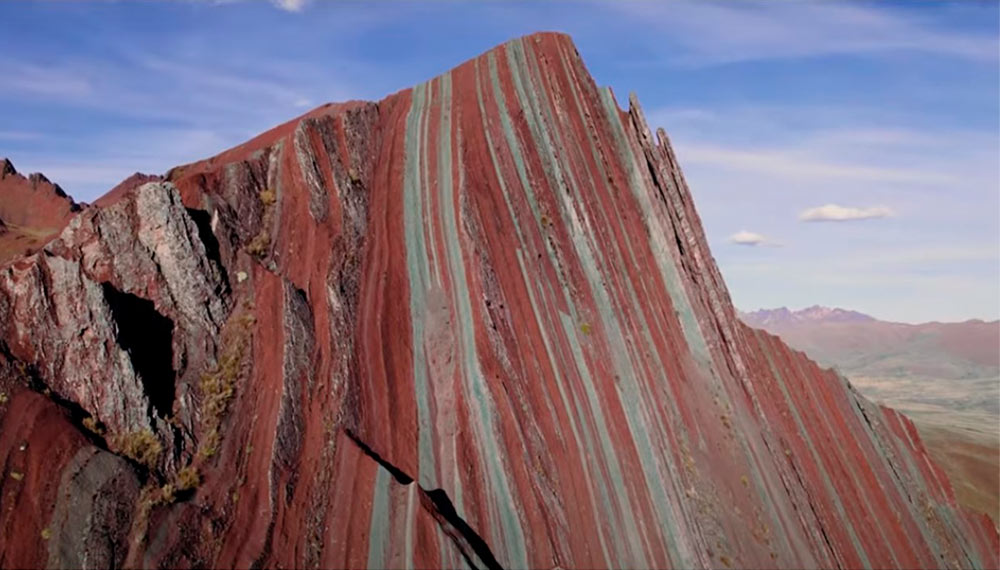
The wonders of nature show us scenarios created to admire and be visited and geological formations with particular characteristics are no exception, from their genesis to the present day. The colorful mountains spread throughout the world do not cease to admire millions of adventurers in search for delight, the colorful mountains can be found in the Zhangye Danxia National Park of the Gansu Province in China, in Latin America in the ravine of the indigenous town of Purmamarca in the province of San Salvador de Jujuy in the north of Argentina and known also as a hill of seven colors. We will give more attention to beautiful geological formations that occur in Our beloved Peru, especially in the Cusco region. The best known are Vinicunca, Palccoyo and Pallay Punchu, all of them are found in the so-called high provinces of Cusco such as Quispicanchis and Canchis.
Also known as the Mountain of Colors of Cusco, Winicunca, Mountain of seven colors of Vinicunca. It is located within the communities of Chilliwani and the Kayrawire property in the districts of Cusipata and Pitumarka, maximum height of the route is 5036 meters above sea level. and the top of Vinicunca is 5200 meters above sea level. It became an iconic attraction in the Cusco region and is the second most visited destination after Machu Picchu.
The Vinicunca Mountain of Colors, known since ancient times since the surrounding communities knew of its existence, used the Abra or Pass of Vinicunca to transport various merchandise as a result of barter exchange or attendance at a local fair, until everything changed with time. the enabling of various roads and modes of transportation. The Vinicunca mountain was used as part of a tourist product of the route of the Sacred Way of Ausangate and to this day it is still in use with a program of 6 days and 5 nights. The original name Vinicunca or Winekunka comes from two Quechua words that are Vini = Dark coloring and Cunca = Neck, Step or Open. Which figuratively would mean Dark Mountain Pass because the mountain divides two valleys.
Spontaneously since 2016, some tourists who were walking around exploring the Ausangate mountain area as part of the itinerary visited the Mountain of Colors and made use of social networks such as Instagram, which years ago was bought by Facebook. Instagram was incorporating several functions such as filters and stickers to the instant publication in its Intagram Stories mode, so some users shared photographs of Vinicunca and it went viral in a short time and from that moment on it has been visited until in recent years it passed from being a destination for only adventurers to being a destination for the majority who want to admire this natural wonder.
The mountain has a conical shape composed of a sedimentary rock formation that originated at the bottom of the sea more than 60 million years ago, a product of the natural erosion of the surface of a proto-continent that progressively sedimented and was arranged according to its density in layers and later in folds with the separation, union and uplift of the tectonic plates that originated the Andes gradually, also considering that it is a polymetallic deposit that contains several minerals such as copper, magnesium, sulfur, gold, silver and mostly iron .
The colors in the mountain are due to the presence of different minerals that entered into the process of oxidation and weathering, the latter causes the mixture of the main colors that generate a colorful spectrum that can currently be witnessed, the colors that stand out the most are:
Mostly all of these minerals went through an oxidation process due to their origin in contact with sea waters.
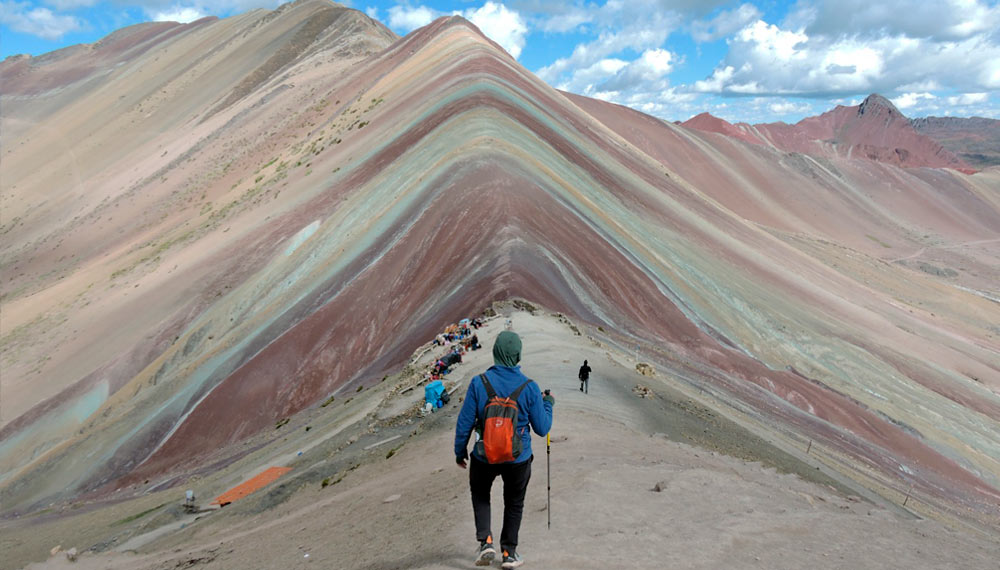
Also known as the second Mountain of Colors of Cusco or Mountains of seven colors of Palccoyo. It is located within the Paccoyo community of the Checacupe district, Canchis province of the Cusco region with a maximum altitude of 4900 meters above sea level. It also became an iconic attraction of the Cusco region next to the colorful mountain of Vinicunca.
The Palccoyo Colored Mountain, known since ancient times as it is located within the community of the same name, is made up of several landscapes where you can see colorful mountain formations, at least you can admire more than three and a forest of rocks. which serves as a natural observatory. Palccoyo became a tourist product a little after the Vinicunca mountain, seeing its success it is shown as a more accessible alternative and at a lower altitude. Not much is known about the original name of Palccoyo, but asking local residents they assert that it comes from the Spanish word-Palco and the Quechua suffix-yoc, Palcco-Yoc which would mean With Palco. Due to the presence of the stone forest formations high up and it serves as a privileged place to have visibility of the surrounding valleys, glaciers and the colorful mountains in the community of Palccoyo. The mere fact of visiting the Puna geographical area gives the visitor an opportunity to admire the rural life of the native peoples who still preserve many traditions, the unique landscape of the high Andes steppe desert on which you can spot wildlife such as deer. Andeans, vizcachas, condors and groups of vicuñas that appear and walk freely over the colorful mountains.
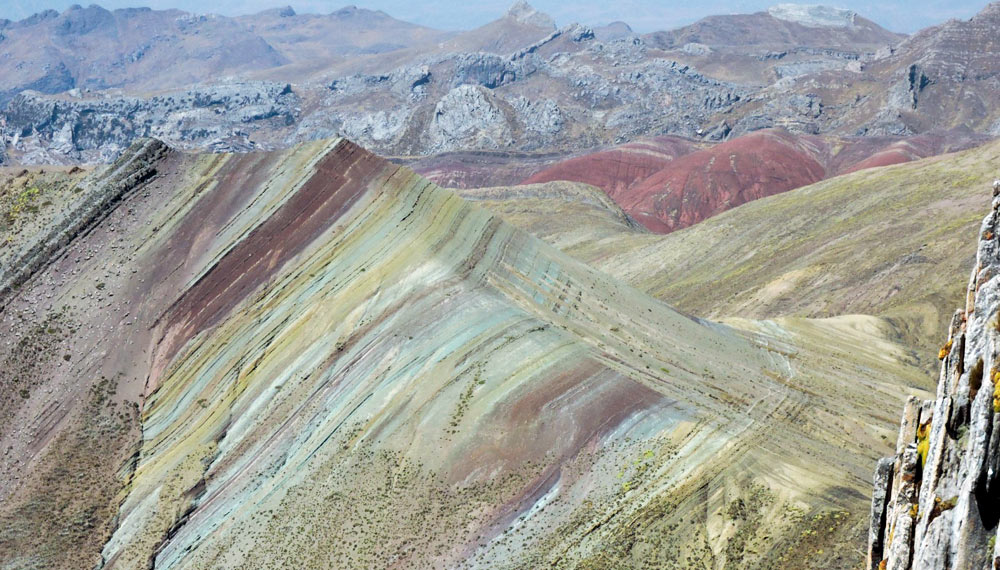
The geographical area is shared between the districts of Layo, province of Canas and the district of Maranganí, province of Canchis, originally known as Apu Taqllo, Apu t'akllo Apacheta, Apu T'acllo or Montaña Filuda de Colores. The maximum altitude of the visit to this natural wonder is 4650 meters above sea level. It is composed of sedimentary rock and clay formations that show various layers of colors with varieties of shapes and in the background the view of the Langui – Layo lagoon, which is considered the largest freshwater reserve in the region. Like the other colorful mountains, it also houses a special amount of biodiversity typical of the high puna, such as vicuñas, birds such as the Andean condor, the vizcacha and all the lake species of Lake Langui-Layo.
The name comes from two Quechua words Pallay – Punchu which means Pallay: colorful rectangular fabric and Punchu: poncho or warm garment used by men so Pallay Punchu would mean colorful poncho.